



Costa Rica Cosmetic Dentistry and the Science of Dental Anti-Aging: How Your Bite Controls How Old You Look
 Your face is not aging the way you think it is. The sagging you see in the mirror each morning, he softening jawline, the folds running from nose to mouth, the upper lip that seems to be disappearing a millimeter at a time, is frequently not a skin problem at all. It is a structural collapse, and it starts in your bite. That is the bottom line, and it is the single most overlooked mechanism in modern facial aging. Costa Rica cosmetic dentistry has quietly become the place where patients from the United States and Canada come to reverse it, at a cost that makes the equivalent treatment at home look almost unreasonable.
Here is the frustrating part. Millions of people spend a decade and tens of thousands of dollars chasing this problem from the outside in: serums, lasers, fillers, threads, surgical lifts, and watch the results fade faster each round. They are treating the canvas of a tent that has lost its poles. Every worn-down molar, every extracted tooth, every year of grinding shortens the vertical scaffolding that holds your lower face at its proper height. Pull the poles down and the fabric folds. No amount of tightening the canvas puts the height back.
At Flikier Dental Institute, we rebuild the poles. We restore the bite to its correct dimension, reload the bone with functional implants, and let the face lift itself from underneath. That is dental rejuvenation, and this article explains exactly how the mechanism works.
🏗️ Your Face Is a Building — and Your Teeth Are the Load-Bearing Walls
 Think about an old house with a settling foundation. The doors stop closing properly. Cracks open above the window frames. The floors develop a slope you can feel in your ankles. You could repaint every wall in the house twice a year, and the cracks would keep coming back, since paint was never the problem.
Your lower face works on the identical principle. The soft tissue, skin, muscle, fat pads, and lips drape over a hard framework made of your jawbones and the teeth mounted in them. That framework establishes three things at once:
- The height of your lower face from the base of your nose to the bottom of your chin
- The forward projection of your lips, which rest against the front teeth and the bone ridge behind them
- The width and definition of your jawline, held out by the volume of bone in the mandible
Take away tooth structure and every one of those three measurements shrinks. The skin does not shrink with it. It has nowhere to go except into folds. So when someone tells you that you look tired, and you have been sleeping eight hours a night, the message may be coming from your molars.
📏 Vertical Dimension of Occlusion: The Measurement Nobody Ever Told You About
 Dentists have a term for the height of your lower face when your back teeth are closed together: the vertical dimension of occlusion, or VDO. It is a real, measurable number, and it is supposed to stay stable across your adult life.
For most people it does not.
Enamel wears. Grinding at night flattens the cusps of the molars. Acid erosion from citrus, wine, soda, or reflux thins the chewing surfaces. Old fillings and crowns fail and get replaced slightly shorter each time. Teeth go missing, and the neighbors drift and tip into the gap. Each of these events removes a fraction of a millimeter of height. Stack twenty years of them together and the jaw closes further than it was built to close.
What happens then? The chin rotates up and forward. The distance between nose and chin compresses. The lips lose their platform and roll inward. The corners of the mouth turn down into a permanent slight frown, and the fold running from the nostril to the corner of the mouth deepens into a trench. Patients describe the result as looking “sunken,” “pinched,” or “angry when I’m not angry.”
So what’s the bottom line? A person who has lost three or four millimeters of vertical dimension can look ten to fifteen years older than their chronological age — and no dermatologist can give those millimeters back.
The overclosure checklist
Run through this list honestly:
- Your front teeth look shorter than they did in photos from your thirties
- Your chin appears to jut forward more than it used to
- Your upper lip has thinned and shows less tooth when you smile
- Vertical lines have formed around your mouth
- Your jaw feels tight, clicks, or aches by evening
- Your dentist has mentioned wear facets, cracked teeth, or a night guard
Three or more of these and you are looking at a bite that has lost height, not a face that has simply gotten older.
🤔 Bone Resorption: The Quiet Countdown That Begins the Day a Tooth Leaves
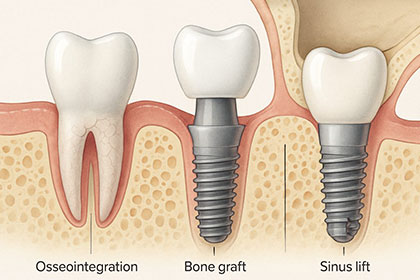 Bone is living tissue, and it obeys a simple rule: use it or lose it. The jawbone that surrounds a tooth root exists for one purpose: to hold that root. Every time you chew, the root transmits force into the surrounding bone, and that stimulus tells the body to keep the bone dense and full.
Pull the tooth and the signal stops.
The resorption that follows is fast and well documented. The bone ridge loses a substantial share of its width within the first twelve months after an extraction, and the volume keeps declining for years afterward. The ridge narrows, shortens, and flattens. A patient who lost a molar at forty-five arrives at sixty with a jaw that has visibly less bone to work with — and a face that has less to sit on.
Traditional dentures accelerate the problem rather than solving it. A denture rests on top of the gum tissue and presses down on the ridge with every bite. It transmits no stimulus into the bone at all, and the constant pressure speeds the shrinkage. This is the mechanism behind the classic collapsed profile of long-term denture wearers, and it is why a denture that fit beautifully in year one rocks and slips by year five. The mouth underneath it is literally getting smaller.
Dental implants are the only restoration that interrupts this.
A titanium implant integrates into the bone and transmits chewing force the way a natural root does. The bone reads that signal and holds its volume. That is the entire clinical argument for Costa Rica dental implants over removable alternatives: not comfort, not aesthetics, but the preservation of the facial scaffold itself.
💋 Collapsed Lip Support and the Deepening Nasolabial Fold
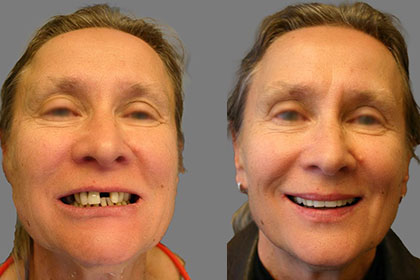 Press your tongue against the back of your upper front teeth. Feel that? Your lips are resting on a shelf made of teeth and the bone ridge behind them. That shelf sets how far forward your lips project and how much red vermilion shows when your mouth is at rest.
When the shelf recedes — through tooth loss, ridge resorption, or worn-down front teeth — the lips fold backward over the edge. Several things follow in sequence:
- The upper lip lengthens and flattens. You show less tooth when you speak and smile, which reads instantly as age, since young smiles display more incisor.
- Fine vertical lines appear around the mouth as the muscle bunches with no structure to spread across.
- The nasolabial folds deepen, since the cheek tissue is no longer held forward and slides down against the fixed crease.
- Marionette lines form at the corners, and the jawline softens into jowls as tissue that once sat on bone migrates downward.
Every one of these is a downstream symptom of one upstream cause. Treat the symptoms individually, and you are, at best, renting a result.
💉 Why Fillers Keep Disappointing on Patients Who Need Structure
 We want to be fair here. Injectables do excellent work on genuine volume loss in the midface, and plenty of our patients combine both approaches with great outcomes.
But filler cannot manufacture vertical height.
A syringe of hyaluronic acid placed into a nasolabial fold adds volume beside the crease. It does nothing about the fact that the jaw underneath is closing three millimeters too far, or that the bone ridge holding the lip has lost a third of its width.
Injecting soft tissue into a collapsed frame gives you a fuller version of the same collapse, and patients often sense something is off without being able to name it.
The result reads as “worked on” rather than “younger.”
Sounds simple, right? Here’s the catch: Rebuilding a bite is far more demanding than a fifteen-minute injection appointment.
It requires diagnostic precision, and precision is exactly where clinic selection stops being a matter of preference.
🔬 How We Rebuild the Scaffold: Our Dental Rejuvenation Protocol
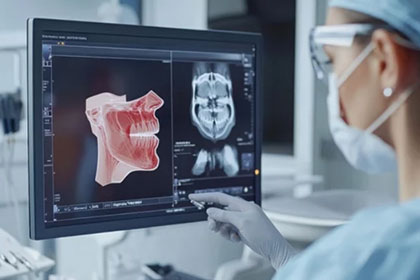 Restoring vertical dimension is not a matter of gluing on longer teeth and hoping the muscles cooperate. Open a bite too far, and the patient cannot chew, speaks with a lisp, and develops joint pain. Open it too little and nothing changes. The margin for error is measured in fractions of a millimeter across the entire arch. Our sequence:
- Photogrammetry and digital facial analysis. We capture the position of the jaws and implant sites with photogrammetric scanning, which records spatial relationships with accuracy that impressions and conventional scanners cannot approach across a full arch. We map current vertical dimension against your facial proportions and against photographs of you at a younger age.
- Diagnostic prototyping. Before anything permanent happens, we build the proposed new dimension into a trial restoration. You wear it. You chew with it. You look at yourself in it. The face you will get is the face you approve.
- Structural rebuild. Depending on what remains, this means: implants, All-on-4 full-arch restoration, full mouth reconstruction with crowns and onlays, or a combination. Implant positions are planned around bone preservation and lip support, not just mechanical stability.
- In-house CAD/CAM milling. Our restorations are designed and milled inside our own laboratory. Nothing ships out. Nothing waits three weeks in a queue. Adjustments happen the same day, with the patient in the chair and the technician down the hall.
- Occlusal refinement. The new dimension gets tested, measured, and refined until the joints, muscles, and teeth agree with each other.
The outcome patients notice first is rarely the teeth. It is the mirror at the airport on the way home, when the lower third of the face has regained its height, and the folds have softened on their own.
🇨🇷 Why Costa Rica Cosmetic Dentistry Delivers This at a Fraction of U.S. Pricing
 Full mouth reconstruction in the United States commonly runs between $60,000 and $120,000. Comprehensive dental treatments at our institute land at a fraction of that figure — and the gap has nothing to do with cutting corners.
Where does the difference come from?
- Overhead and cost of living in Costa Rica run dramatically lower than in major U.S. metros, and dental fees follow the local economy rather than Manhattan commercial rents.
- No insurance administration layer. U.S. practices carry enormous billing and coding infrastructure. We do not.
- Our laboratory is in the building. Outsourced lab work carries markup at every stage. Ours does not leave the premises.
- Specialist training is world-class. Costa Rican dental education is rigorous, and our team holds advanced credentials from institutions in the United States and Europe.
Add the treatment timeline. Same-day capability compresses a reconstruction that would demand six to eight separate appointments across a year at home into a single planned trip, with bilingual coordination handling scheduling, transport, and lodging from your first message to your flight out.
One more thing worth weighing: the clock on bone resorption keeps running during those years of waiting for the budget to work at home. Time spent postponing treatment is bone volume you do not get back.
⏰ The Case for Acting Sooner Rather Than Later
 Structural aging compounds. A single lost molar shifts the load onto its neighbors, which wear faster, which crack, which get extracted. The bite closes a little further each year. The ridge narrows. The face folds a little deeper.
Every year of delay makes the eventual rebuild larger, longer, and more expensive.
- Patients who arrive at forty-eight with two missing molars and moderate wear get a straightforward, conservative reconstruction.
- The same patient at sixty-two, with six missing teeth and a resorbed ridge, needs grafting, more implants, and a longer treatment plan.
Catch it early. Rebuild the frame while there is still frame to build on.
The Takeaway
Facial aging in the lower third of the face is largely a mechanical story, and mechanical stories have mechanical solutions. Your bite sets the height of your face. Your tooth roots keep your jawbone alive. Your front teeth hold your lips forward. Lose those three inputs and no topical treatment on earth will hold the line.
Our team treats aging where it actually originates, in the structure. If you recognized yourself in the overclosure checklist earlier.
We invite you to send us recent photographs and any existing scans for a complimentary assessment.
We will tell you plainly what your bite is doing to your face, what restoring it would involve, and what it would cost. No obligation, no pressure, and an honest answer either way.
Rebuild the poles. The canvas takes care of itself.
 Or Call Toll Free 1-866-638-1102


 If your file is bigger than 20 Megs you can use our Dropbox account.
